







Key Takeaways
Men's skin does show measurable average differences from women's skin – but not enough to require an entirely different set of formulations. What matters far more for a beginner skincare routine for men is simple: cleanse properly, support what the barrier already does well, and protect it from UV, chosen by skin goal or concern, rather than gender. This article covers what the research actually shows, and a considered three-step ritual to start with.
In the past five years, the number of Australian men with an established skincare ritual has grown by almost 21%, to 2.19 million – with the fastest growth among men in their late twenties and early thirties (Roy Morgan Research, 2025). For most of them, the more useful question isn't whether men's skin is different from women's skin – in some measurable ways, it is – but whether that difference actually changes what an effective ritual looks like. It doesn't, in any way that matters for where to start.
RATIONALE doesn't divide skincare into a men's version and a women's version. Every client, regardless of gender, is guided toward the same fundamentals (protect by day, repair by night) drawn from the same Essential Six framework and chosen by skin concern or type, rather than who a formulation appears to be marketed at. For a beginner skincare routine for men, that's genuinely good news: it means starting simply, with formulations that work the same way for anyone.
This article looks at what the research actually shows about men's and women's skin, the small handful of genuine differences worth knowing about, and—the part that matters most in practice—a simple ritual to start with, along with how it adapts as your skin changes over the years.
Is Men's Skin Really Different from Women's Skin?
Yes, in some measurable ways. Reviewing accumulated dermatological literature finds that men's skin, on average, is somewhat thicker, produces a little more sebum, carries a different collagen density, and loses more water through the surface than women's skin – while women's skin tends to sit at a slightly higher, less acidic pH (Rahrovan et al., International Journal of Women's Dermatology, 2018). These are genuine, structural differences, and it would be inaccurate to claim otherwise.
What's less often said is how small some of these differences look once they're properly measured. A well-controlled 2013 study measuring residual skin surface components across a large participant pool found no statistically significant difference in sebum output between men and women at all, once individual variation was properly accounted for (Shetage et al., Skin Research and Technology, 2013). Sebum is the difference most often pointed to as a reason for a different approach, so it's a useful reminder that averages and any one person's skin don't always tell the same story.
At a glance: Men's skin, on average is somewhat thicker, moderately more sebum-producing (though not always a statistically significant difference), slightly more acidic, with comparable age-related collagen decline once lifestyle factors like solar exposure are accounted for.
None of this changes what actually works. The differences sit within a shared, largely overlapping range and closer to the natural variation between any two people than to two categories requiring two different approaches. That's why the same Essential Six framework that guides any RATIONALE ritual applies just as well here as they do for any client.


The Same Fundamentals Apply, Regardless of Gender
Despite the concept of “men’s skincare” existing in the market as a separate category for years, the underlying skin science simply doesn’t support it.
The American Academy of Dermatology, which acknowledges that men's skin is on average thicker than women's, concludes that "the basic elements of an effective skin care plan remain the same" regardless. A 45-year-old man who spends his weekends outdoors and a 45-year-old woman who does the same have more in common, skin-wise, than either of them has with a 25-year-old of the same gender who mostly stays indoors; age and lifestyle, not gender, are doing the real work here.
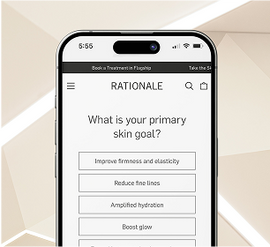
That's useful, because it simplifies the decision considerably. Formulation choice follows what a client's skin is doing – supporting a compromised-feeling barrier, protecting against solar and environmental damage, refining texture, or supporting visible renewal – drawn from the same Essential Six Collections regardless of who's asking. It's precisely the thinking behind the RATIONALE Skin Questionnaire, which builds a ritual around a client's individual needs, not their gender.
What Should Men Start With? A Simple Three-Step Ritual
Because purging and an ordinary breakout can look similar at a glance, it helps to have a clear way to tell them apart.
Skin purging – appears in areas where you would already expect congestion (T-zone, jawline); made up of smaller, similar-looking bumps; tends to ease within a matter of weeks; occurs after introducing an active that increases cell turnover (Hydroxy Acids, Retinol, Retinal).
Breaking out – can appear in new areas you don't usually experience congestion; often includes larger, more inflamed or varied blemishes; tends to persist or worsen rather than ease over time; can follow a formulation that doesn't suit your skin, a change in season, hormones, or an unrelated trigger.
The most reliable signal is trajectory. Purging follows a curve; it tends to peak and then visibly settle as your skin completes its adjustment. A breakout, by contrast, tends to hold steady or worsen the longer a formulation continues, and it is more likely to show up in places your skin doesn't usually experience congestion. If what you are seeing is easing week by week, that is a good indication of purging. If it is holding firm or spreading after several weeks, that is worth treating as a breakout and reconsidering the formulation.
Adapting the Ritual as Your Skin Changes
Moving through life, especially into your thirties and forties, changes like fine lines, uneven texture, or a complexion that looks less immediately recovered after a bad night's sleep become more noticeable. It's tempting to read this as a new, more urgent men's concern, but it's the same age-and-lifestyle story from earlier in this article, not a new gendered one. Solar and environmental damage accumulates over years regardless of gender, and its visible effects simply become harder to overlook with time.
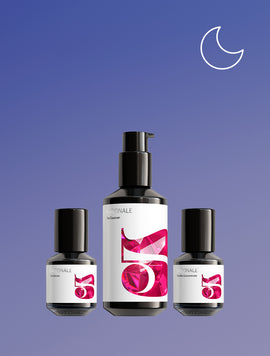
The good news is that adapting doesn't mean starting again. The same three-step foundation continues; what typically changes is layering in one or two formulations, once the basics are established, drawn from the same Essential Six framework as the above three.
In the morning, that's usually an antioxidant complex. Solar and environmental exposure accumulates as free-radical damage, and Vitamin C remains one of the most researched actives for defending against it while supporting a brighter, more even-looking complexion over time. #2 The Strengthening Serum is built around a Multi-Vitamin Antioxidant Complex including Vitamin C, formulated to visibly brighten and even skin tone alongside daily antioxidant defence – applied after the barrier-support step and before SPF. In a 56-day trial, 95% of participants reported improved hydration, and 84% saw enhanced brightness and radiance.
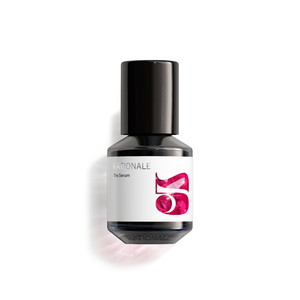
In the evening, the equivalent addition is one that supports the skin's own pH and texture. As turnover slows with age, texture and tone can start to look less even. A Hydroxy Acid formulation helps maintain the skin's natural pH balance and supports a smoother-looking surface without undoing the barrier work already being done elsewhere in the ritual. #5 The Refining Serum uses a proprietary complex of Hydroxy Acids and Peptides to visibly refine texture and support skin pH overnight. In a 28-day trial, 91% of participants saw an improvement in even skin tone, and 75% experienced increased firmness.
A third common evening addition targets visible signs of ageing more directly. #6 The Rejuvenating Night Crème combines a Vitamin A Complex of Retinol and Retinal with DNA Repair Enzymes, formulated to visibly firm skin, help improve the look of fine lines, and deliver lasting hydration overnight.
None of this needs to happen at once. Hydroxy Acid and Vitamin A formulations in particular are best introduced gradually – two to three nights a week to begin, building up as skin adjusts – and most clients add one at a time rather than all three together. These become the ritual's next steps for clients in their thirties and beyond, still chosen by skin type and need, from the same Essential Six framework.
A Note on Shaving
Shaving is genuinely specific to a portion of RATIONALE's clients, so it's worth addressing directly—but as a behavioural factor, not a biological one. Research combining controlled tape-strip exfoliation with skin-equivalent modelling has shown that shaving causes measurable mechanical disruption to the skin's protective barrier, including increased cell turnover, thickening, and temporarily impaired barrier function – effectively a repeated, self-administered exfoliation (Costello et al., Frontiers in Medicine, 2023). That's a consequence of the behaviour, not evidence of fundamentally different underlying skin.
The practical implication is straightforward: skin that's shaved regularly benefits from a little more barrier support afterward, the same way skin recovering from any repeated mechanical stress would. #4 The Nourishing Crème is formulated with six forms of ceramides, designed to comfort and support the barrier. In a 56-day trial, 95% of participants reported improved hydration and nourishment, and 90% experienced increased firmness. Applied after shaving, it plays a supportive role where the barrier needs a little help.
Insider tip: we often recommend adding a layer of #4 The Nourishing PreCleanse Balm to skin, then #4 The Nourishing Cleanser as a shaving medium. This soothing alternative to shaving cream helps reduce visible signs of irritation and sensitivity. After shaving, emulsify with water and rinse.
Begin Wherever Your Skin Actually Is
None of this requires overhauling anything before starting – it requires a simplified approach and a few weeks of consistency. To help understand your needs further, the RATIONALE Skin Questionnaire builds a ritual around your own skin concerns in a few minutes.
Frequently Asked Questions
In the sense that all human skin requires the same fundamental support and six pillars of health, yes. More specifically to an individual? We always recommend starting from a place of knowledge about your unique needs and concerns. This may be achieved through a Signature Consultation in Flagship, via Virtual Consultation, or even online with our Skin Questionnaire. From there, a ritual is built based on the delivery systems and textures that best suit your individual needs and preferences—rather than using it just because your partner does.
The same one. #1 The Strengthening Serum is recommended to any client dealing with reactivity or a barrier that needs support, regardless of gender – Niacinamide doesn't behave differently depending on who's applying it. A separate men's formulation would only make sense if the underlying skin need were different, and as the research above shows, it typically isn't. The only reason to choose a different serum is a different Skin Goal, not a different gender.
Lightest to heaviest, water-based before oil-based, then the SPF formulation last, allowing each layer a moment to settle before the next goes on. Getting the order wrong doesn't undo the benefits entirely, but it does mean later steps can't absorb as effectively.
Yes – Australia's UV environment makes daily protection a baseline rather than an optional step. Solar and environmental damage accumulates whether or not it's visible day to day, which is exactly why it's easy to underestimate. #3 The Brilliance Tinted Serum SPF50+ visibly evens tone and shields against UV, visible, and infrared light, and should be reapplied through the day for continued protection, the same as any SPF formulation.
Overcomplicating it before the basics are in place, like adding several actives at once, or skipping SPF because it feels like an extra step rather than the most important one. The second most common mistake is stopping after a few weeks because nothing dramatic has happened yet, when the more meaningful changes are still building beneath the surface. The simplified ritual above, done consistently, outperforms a longer routine followed inconsistently.
Skin renews itself roughly every 28 days, so surface-level comfort and texture improvements are usually noticeable within a few weeks of consistent use. Deeper changes, such as firmer-looking skin, softened fine lines, tend to develop over eight to twelve weeks. Consistency matters more than intensity here.
Written by Eleni Papadopoulos
Eleni is a skincare writer with a background in the beauty and skincare industry, having spent several years working alongside dermal therapists and formulation teams. Her experience has shaped a practical understanding of skin behaviour, ingredients, and treatment pathways. Eleni focuses on translating complex skincare concepts into clear, considered guidance, with an emphasis on efficacy, routine building, and long-term skin health.
References
1. Rahrovan S, Fanian F, Mehryan P, Humbert P, Firooz A. Male versus female skin: What dermatologists and cosmeticians should know. International Journal of Women’s Dermatology. 2018;4(3):122–130. doi:10.1016/j.ijwd.2018.03.002.
2. Shetage SS, Traynor MJ, Brown MB, Raji M, Graham-Kalio D, Chilcott RP. Effect of ethnicity, gender and age on the amount and composition of residual skin surface components derived from sebum, sweat and epidermal lipids. Skin Research and Technology. 2014;20(1):97–107. doi:10.1111/srt.12091.
3. Costello L, Goncalves K, Maltman V, Barrett N, Shah K, Stephens A, Dicolandrea T, Ambrogio I, Hodgson E, Przyborski S. Development of a novel in vitro strategy to understand the impact of shaving on skin health: combining tape strip exfoliation and human skin equivalent technology. Frontiers in Medicine. 2023;10:1236790. doi:10.3389/fmed.2023.1236790.
4. Roy Morgan. More men are using skincare; up over 20% compared to five years ago. Finding No. 10011. 30 September 2025. Market research; not peer-reviewed academic literature.
5. American Academy of Dermatology. Skin care tips for men. American Academy of Dermatology. Accessed 11 August 2026.
6. Aganahi A, Parker R, Tanaka Y. In Vivo Improvements in Facial Appearance and In Vitro Changes in Gene Expression Using a Topical Formulation Designed to Repair Environmentally Induced DNA Damage. Journal of Cosmetics, Dermatological Sciences and Applications. 2024;14:141–173. doi:10.4236/jcdsa.2024.142010.